


Top Grants for Life Sciences Companies in Canada (2026)
Life sciences is less an industry than a category. Under one label sit biotech firms, drug developers, device makers, diagnostics companies, and digital health startups, and they rarely line up for the same money. What you can actually access depends less on your sub-field than on how far along you are. A two-person spinout from a university lab and a company tooling up to manufacture at scale both belong to life sciences, but almost nothing in their funding plans overlaps.
So this guide is built around where you are, not what you make. Find the stage that sounds like you, start with the programs there, and use the links to go deeper into the guide for your specific field.
Table of Contents
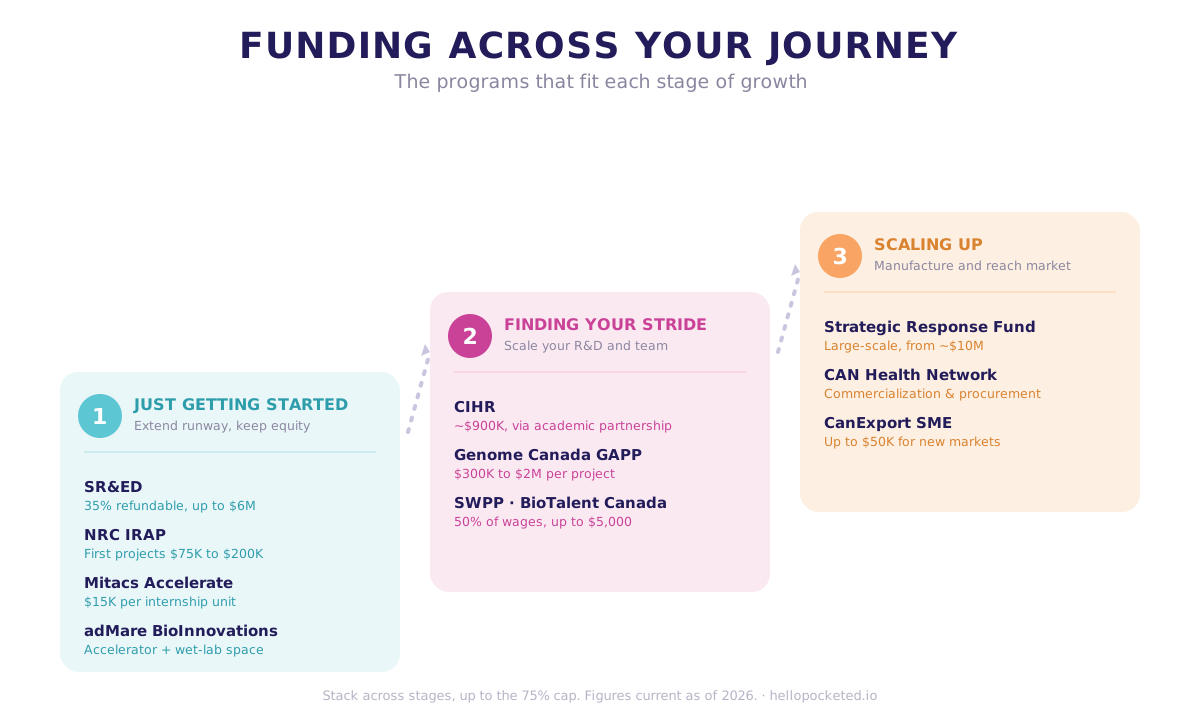
Stage One: Just Getting Started
You have a discovery, maybe a prototype, and a very long road ahead. At this point the goal is simple: extend your runway without giving away equity you cannot spare.
Start with SR&ED. Almost any genuine technical problem-solving you do in Canada qualifies, and for a small Canadian-controlled company the credit is 35% refundable on up to $6 million of eligible work, paid out in cash even when you owe no tax. For an early company with no revenue, that refund cheque matters more than almost anything else on this list.
Next, get to know NRC IRAP early, before you need it. It funds a large share of your technical salaries, and it assigns you an advisor who has usually seen dozens of companies at your stage. First-time projects often land in the $75,000 to $200,000 range, which is real money when you are small.
When you need specialized brainpower you cannot yet hire, Mitacs Accelerate places a graduate researcher or postdoc on your problem for $15,000 per four to six month unit, with Mitacs covering half.
And if you are spinning science out of a lab, adMare BioInnovations is worth knowing well. It is Canada’s life sciences company-builder, and it offers three things a young company rarely has: investment through its Tx Accelerator, wet-lab and office space at its Innovation Centres in Montreal and Vancouver, and talent training through the adMare Academy. It works in exchange for a stake rather than handing out grants, but for the right founder it can be the difference between a paper and a company.
New to all of this? Our 3 Easy Grants to Apply for in 2026 is a gentle place to start.

Stage Two: Finding Your Stride
You have proof your idea works, a small team, and a need to do more serious science without burning out your bank account. This is where research partnerships and hiring support start to pull their weight.
If your work is health-related, the Canadian Institutes of Health Research is the largest health research funder in the country. Its grants are held by academic researchers, so the play here is partnership: team up with a university lab and the funding supports the science you both care about, with project grants that average close to $900,000 over several years.
For anything genomics-related, and that now stretches well beyond drug development into diagnostics, agriculture, and precision health, Genome Canada’s Genomic Applications Partnership Program is built precisely for the company-plus-researcher model. It contributes between $300,000 and $2 million toward a project, up to a third of the total, specifically to push a genomics innovation toward market. Applications run through your regional Genome Centre.
Hiring also gets cheaper at this stage. The Student Work Placement Program, delivered for the sector by BioTalent Canada, covers half a student’s wages up to $5,000, an easy way to build your bench while you grow.
Building a team in earnest? The Ultimate Guide to Hiring Grants covers the rest.
Stage Three: Scaling and Commercializing
Your product works and now has to reach people. The programs here are bigger, slower, and worth the effort.
For large projects, especially anything touching manufacturing, the Strategic Response Fund is the federal heavyweight. It replaced the former Strategic Innovation Fund and backs transformative biomanufacturing and life sciences projects, generally starting around a $10 million contribution. This is the program behind major vaccine and production investments in Canada.
Getting a health product adopted at home is its own hurdle, and the CAN Health Network exists to clear it. Rather than a cheque, it gives you a structured commercialization project inside real hospitals and health authorities, then a streamlined path to procurement across its national network. For a company with regulatory approval and no Canadian customers yet, that pathway is gold.
And when you are ready to sell abroad, CanExport SME reimburses up to $50,000, covering half the cost of entering a new international market.
Go Deeper in Your Field
Life sciences is broad, and the programs above are the ones that cut across all of it. Once you know your lane, the specifics get richer:
If you develop drugs or biologics, read Top Grants for Biopharma and Top Grants for the Pharmaceutical Industry. If you work on the brain, see Top Grants for the Neuroscience Industry, which covers neuroscience-specific funders like Brain Canada and CABHI. And for the wider view of where health and life sciences funding sits, the Healthcare industry hub pulls it together.
The Mistake That Costs the Most
Here is the one thing that separates companies that fund themselves well from those that scramble: they do not treat these programs as either-or.
The biggest missed opportunity in life sciences funding is not a program you have never heard of. It is failing to stack the ones you already know. A single project can carry SR&ED on its costs, IRAP on its salaries, and a Mitacs intern on a hard research question, all at the same time, up to the 75% cap on combined government support. Companies leave real money on the table by running these in sequence, or worse, by claiming only one.
Two habits prevent it. Plan your funding before you spend, because IRAP, Genome Canada, and most direct programs will not reimburse costs you incurred before approval, while SR&ED is the rare one claimed after. And keep a simple map of which program covers which cost, so nothing falls through the gaps.
That mapping is most of what Pocketed does. Our matching platform surfaces every program your company qualifies for at your stage, and our grant writers can prepare the applications with you.
You are working on hard, valuable problems. The funding to keep going is there. The trick is knowing which door to knock on, and when.