



Top Grants for the Neuroscience Industry
Few fields carry as much promise as neuroscience. The work happening in Canadian labs and startups right now, from mapping neural circuits to building the next generation of brain-health devices, has the potential to change millions of lives. It is also expensive, slow, and risky, which is exactly why Canada funds it so heavily.
The catch is that neuroscience funding is scattered across very different programs. Some reward academic discovery. Some pay companies to build and commercialize. Some simply help you hire the right people. Knowing which bucket you fall into, and how the programs fit together, is half the battle.
This guide groups the most important options by what they actually do for you: fund your research and development, help you build your team, and get your product to market. Whether you are a researcher chasing a discovery grant or a founder commercializing a neurotech device, there is a path here for you.
Discover More: For the bigger picture on research funding, start with our Ultimate Guide to Funding Your Innovation Projects.
Table of Contents
What Actually Wins a Neuroscience Grant
Before the programs, it helps to understand how reviewers actually think, because the same five things decide most neuroscience funding outcomes regardless of which door you knock on.
First, fit with the funder’s priorities. Every program has a mandate, and the closest-aligned applications win. Read the guidelines and mirror their language back to them. Second, novelty and significance. Reviewers fund work that fills a real gap or solves a real problem, so make the “why this matters” impossible to miss. Third, feasibility. A bold idea still needs a credible plan, a realistic timeline, and an honest account of the risks. Fourth, the strength of your team. Neuroscience spans disciplines, so the right mix of expertise, and the named people who bring it, carries real weight. Fifth, collaboration. Partners and co-investigators signal that the work is connected to the broader field and has support beyond your own walls.
One more practical note that applies everywhere: build a realistic budget and write clearly. A surprising share of strong science gets passed over because the budget did not add up or the proposal was hard to follow. None of this is glamorous, but it is what separates funded applications from the rest.
Funding for Research and Development
This is where most neuroscience money lives, and it splits cleanly between programs built for companies and programs built for academic researchers.
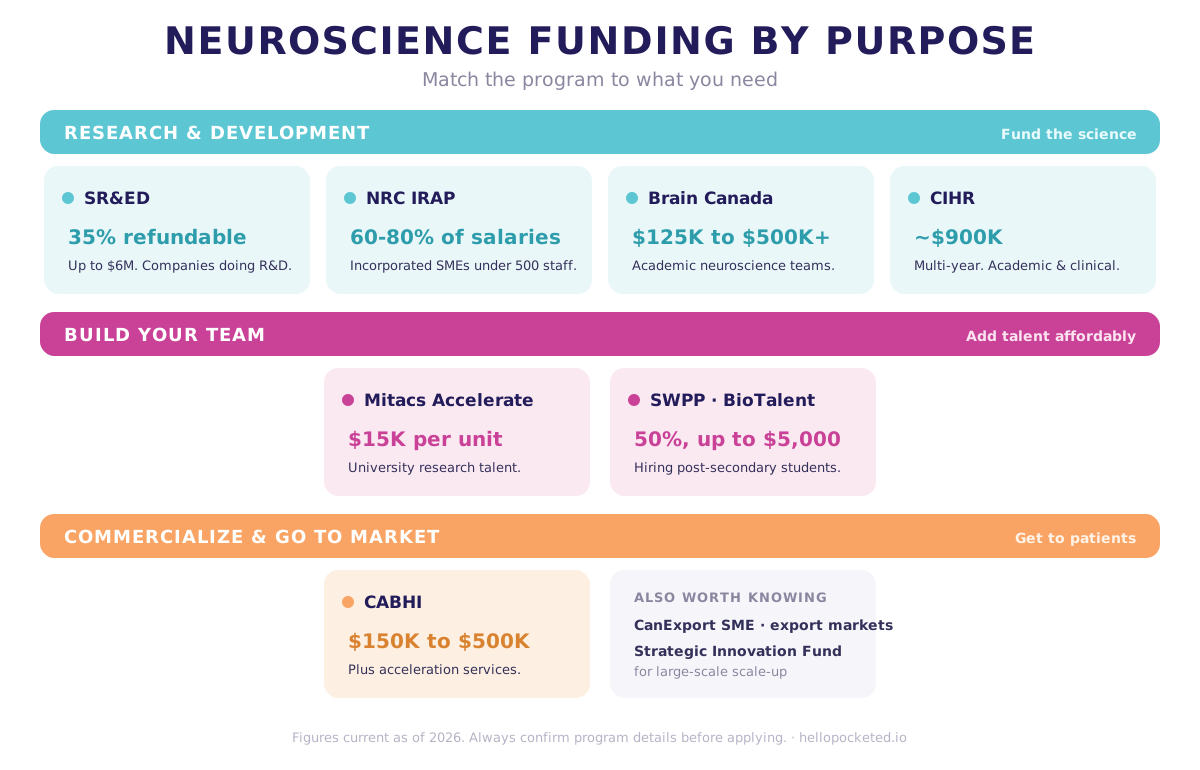
On the company side, the foundation is SR&ED. If you do experimental development in Canada, this tax incentive refunds a meaningful chunk of your R&D costs. As of 2026, Canadian-controlled private corporations can claim a 35% refundable credit on up to $6 million of eligible spending, worth as much as $2.1 million back per year, and recent changes restored eligibility for capital equipment. It is the layer almost everything else stacks on top of.
Alongside it sits NRC IRAP, the National Research Council’s program for technology-driven small and medium businesses. Where SR&ED pays you back after the fact, IRAP funds the work as it happens, covering roughly 60% to 80% of your technical salaries, and it pairs the money with an Industrial Technology Advisor who guides the project. Contributions commonly run from $50,000 to several million, and eligibility is straightforward: an incorporated, for-profit Canadian business with 500 or fewer employees.
On the academic side, Brain Canada is the marquee neuroscience funder. Backed by the federally matched Canada Brain Research Fund, it supports the full research continuum through Team Grants, Platform Support Grants, and Capacity Building Grants for early-career scientists. Its discovery programs range from seed awards around $125,000 to development and team grants of $500,000 and well beyond, all awarded through rigorous peer review.
The other academic giant is CIHR, Canada’s federal health research agency, which houses a dedicated Institute of Neurosciences, Mental Health and Addiction. Its flagship Project Grant program runs twice a year and funds health research at any career stage, from discovery through to application. Awards are large and multi-year, averaging close to $900,000 over roughly four and a half years, though the competition is genuinely fierce.
Doing custom software or device development? Our SR&ED specialists can handle the claim, and our Guide to SR&ED Tax Credits breaks down the details.

Funding to Build Your Team
Neuroscience runs on people, and two programs make hiring far cheaper.
Mitacs Accelerate connects you with graduate students and postdoctoral researchers from Canadian universities to work on your research challenge. Each four to six month internship unit is funded at $15,000, of which Mitacs contributes half, so you tap into serious research talent at a fraction of the cost. Life sciences is one of its strongest disciplines, which makes it a natural fit for neuroscience teams. A quick heads-up worth planning around: provincial allocations tightened in the 2025/26 cycle, so confirm availability with a Mitacs advisor before you count on units.
For earlier-career talent, the Student Work Placement Program subsidizes post-secondary student placements, and for life sciences it is delivered by BioTalent Canada, the HR partner for Canada’s bio-economy. It covers 50% of a student’s wages, up to $5,000 per placement, which is an easy way to add capacity without a senior-hire budget.
For the full picture on hiring support, see our Ultimate Guide to Hiring Grants.
Funding to Commercialize and Go to Market
Getting from a working prototype to a product in clinics is its own challenge, and this is the stage the original neuroscience funding landscape most often overlooks.
The standout here is CABHI, the Centre for Aging + Brain Health Innovation, powered by Baycrest. It is a solution accelerator built specifically for brain-health and neurotech companies, and it combines funding with hands-on commercialization support: business development, validation with real user groups, and access to its healthcare network. Its Ignite program offers up to $150,000 for early-stage solutions, and larger awards reach $500,000 through other streams. The track record is real, with more than 60% of funded companies going on to secure follow-on investment.
Beyond CABHI, two federal options round out the commercialization picture. CanExport SME helps cover the cost of breaking into new international markets, which matters for neurotech companies selling beyond Canada. And for large-scale projects, the Strategic Innovation Fund supports major research, scale-up, and commercialization investments. Both run on their own criteria and timelines, so check current intakes before building them into a plan.
Utilize Pocketed’s platform or hire a grant writer to streamline any of these applications.
The Programs at a Glance
How to Put It All Together
The companies and labs that fund their work best rarely rely on a single program. They layer them. A neurotech startup might claim SR&ED on its development costs, fund salaries through IRAP, add a Mitacs intern for a specialized research question, and tap CABHI to commercialize, all while staying under the 75% cap on combined government support. An academic team might pair a CIHR Project Grant with Brain Canada team funding and Mitacs interns.
The trick is matching the program to the need and minding the timing, since IRAP and Mitacs need approval before you spend while SR&ED is claimed after. That is a lot to track, which is where we come in. Pocketed’s intelligent matching platform surfaces every program your neuroscience business qualifies for, and our expert grant writers can take the application off your plate.
Canada wants to fund the frontiers of the mind. With the right plan, you can make sure your work is part of it.