


Top grants for the Pharmaceutical industry (2026)
A new medicine can take a decade and more than a billion dollars to bring to patients. For a Canadian pharmaceutical company, whether it is a two-person startup or an established manufacturer, that math is daunting. The good news is that Canada funds this sector at every step, from the first experiment in the lab to the moment a product reaches a hospital formulary. The money is there. The hard part is knowing which program fits where you are.
This guide sorts the best options by what you are actually trying to fund: your research, your team, and your route to market. Pick the goal in front of you and start there.
Discover More: Working specifically in biologics or drug discovery? Our Top Grants for Biopharma guide goes deeper on that side. For the broad view on research funding, see the Ultimate Guide to Funding Your Innovation Projects.
Table of Contents
What Actually Wins a Pharma Grant
A few things decide most funding outcomes, and they are worth getting right before you write a word of an application.
Know the funder. Read what the program actually funds, who has won it before, and what it asks for, then shape your application to that rather than sending the same proposal everywhere. Write it so a non-specialist can follow it, because the reviewer scoring your file may not share your therapeutic expertise. Lead with patient impact, since in this sector the question behind every grant is whether the work improves care, and a clear answer to that question carries real weight. Back your claims with data, because preliminary results and a credible plan separate a fundable project from a hopeful one. And follow the guidelines exactly, since a missed requirement is one of the most common reasons strong applications get cut.
None of that guarantees a win, but skipping it almost guarantees a loss.
Fund Your Research and Development
R&D is where the deepest pharma funding sits, and most companies will draw on more than one of these.
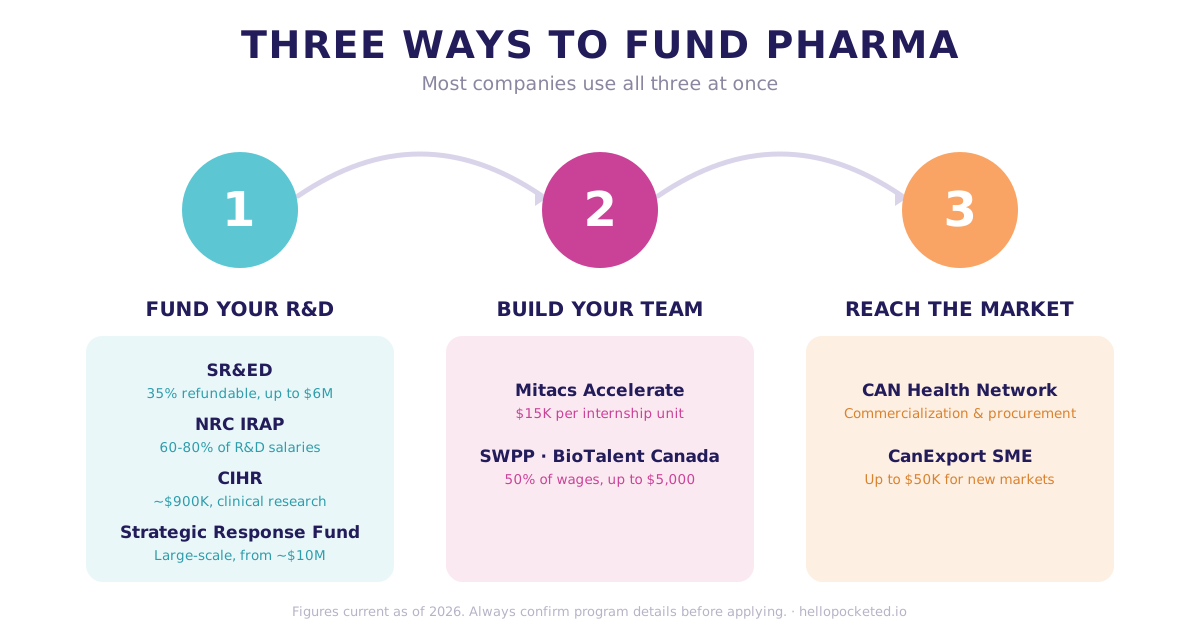
Your starting point is SR&ED. Formulation work, process development, analytical method development, and similar technical problem-solving usually qualify as experimental development. As of 2026, Canadian-controlled private corporations can claim a 35% refundable credit on up to $6 million of eligible R&D, returning as much as $2.1 million in cash each year, with capital equipment now eligible again. Nearly every company in this sector should be claiming it.
For funding that arrives while the work is happening rather than after, NRC IRAP reimburses roughly 60% to 80% of the salaries of staff doing technical R&D, and it assigns you an advisor who helps shape the project. It is open to incorporated Canadian businesses with fewer than 500 employees.
On the research and clinical side, the Canadian Institutes of Health Research is the country’s largest health research funder. Its Project Grant program runs twice a year and supports work from discovery through clinical application, with awards that average close to $900,000 over several years. These grants are held at universities and research institutions, so they typically involve an academic partnership, which is a common and productive route for companies running trials or early-stage science.
When the project is large, the program to know is the Strategic Response Fund, which replaced the former Strategic Innovation Fund and continues to back big, transformative projects in biomanufacturing and life sciences. This is the vehicle behind major vaccine and manufacturing investments in Canada, so it suits companies building production capacity or running a project at real scale, generally starting around a $10 million contribution. For applied research and talent that feeds the same ecosystem, the Canada Biomedical Research Fund is worth watching as part of Canada’s broader biomanufacturing strategy.
Doing custom development? Our SR&ED specialists can handle the claim.
Build Your Team
Specialized talent is one of the biggest costs in pharma, and two programs take the edge off.
Mitacs Accelerate pairs you with graduate students and postdoctoral researchers from Canadian universities to work on a defined research question. Each four to six month internship unit runs $15,000, and Mitacs covers half, so you bring in serious research capability at a modest cost. For earlier-career hiring, the Student Work Placement Program, delivered for the life sciences by BioTalent Canada, covers 50% of a student’s wages to a maximum of $5,000 per placement.
For the full picture, see our Ultimate Guide to Hiring Grants.
Reach the Market
A finished product still has to find its way onto shelves and into hospitals, and this is the stage companies most often underfund.
The standout here is the CAN Health Network, a federally backed marketplace that connects Canadian health technology companies with hospitals and health authorities across the country. Rather than a cash grant, it offers something arguably more valuable: a structured commercialization project where you validate your product in real clinical settings, then a streamlined path to procurement across its network of health system members. For a company that has cleared regulatory approval and needs its first real customers, that pathway can be the difference between selling at home and going abroad to grow.
To expand beyond Canada, CanExport SME reimburses up to $50,000, covering up to half the cost of entering a new international market, which can include the market research, regulatory work, and travel that international expansion demands.
The Programs at a Glance
How to Put It All Together
Most companies that fund themselves well use several of these at once. A clinical-stage firm might claim SR&ED on its development costs, cover technical salaries through IRAP, run a trial in partnership with a CIHR-funded researcher, and line up a CAN Health Network project for the moment it has approval in hand. The two rules that keep this clean are simple. Match each program to the goal in front of you, and mind the timing, since IRAP and most direct programs need approval before you spend while SR&ED is claimed after the fact. Government support from all sources combined also cannot exceed 75% of a project’s eligible costs.
Tracking all of this across half a dozen agencies is its own job. Pocketed’s intelligent matching platform surfaces every program your pharmaceutical business qualifies for, and our expert grant writers can prepare and submit the applications with you.
The funding to move a medicine from the lab to the patient exists in Canada. The right plan is what unlocks it.