
Bringing a new therapy from the lab bench to a patient’s bedside is one of the most expensive journeys in business. Discovery, preclinical work, trials, regulatory approval — the timelines are long and the burn rate is real. The good news? Canada funds this work generously, precisely because biotechnology and life sciences are national innovation priorities.
The challenge is knowing which programs fit your stage and how to stack them. This guide breaks down the four funding programs that matter most for Canadian biopharma companies in 2026 — what each pays, who qualifies, and how they work together.
Discover More: For the bigger picture on R&D funding, see our Ultimate Guide to Funding Your Innovation Projects.
Table of Contents
Why Biopharma Is So Fundable in Canada
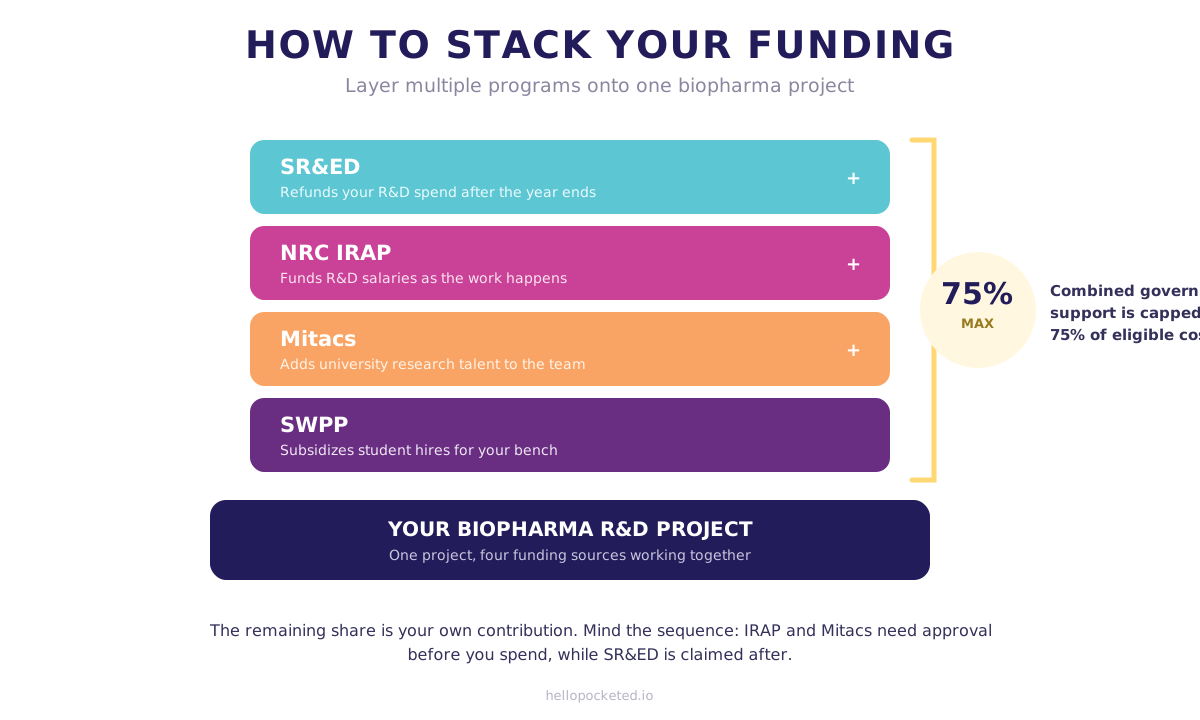
Think of Canada’s funding system as a layered cake rather than a single slice. The federal government treats biotechnology and life sciences as a high-priority subsector — work that improves public health and builds domestic capacity, so the support spans tax credits, direct R&D grants, research-talent programs, and hiring subsidies. The smartest biopharma companies don’t pick one; they stack several on the same project, up to the 75% total-government-assistance cap.
Here are the four that form the backbone of a Canadian biopharma funding stack.
Grant #1 — SR&ED Tax Credit
Funding: Up to 35% refundable on the first $6M of eligible R&D (max ~$2.1M/year)
If you do any laboratory or experimental development work in Canada, SR&ED is the foundation everything else stacks on. It’s a Canada Revenue Agency tax incentive that refunds a portion of your R&D salaries, materials, and Canadian subcontractor costs — and as of 2026, capital equipment again qualifies too.
What you can get:
- 35% refundable credit for Canadian-controlled private corporations (CCPCs) on up to $6 million of qualifying R&D — a maximum of about $2.1 million in cash back per year.
- 15% basic credit on expenditures above that, or for most other corporations.
- Recent Bill C-15 changes (royal assent March 2026) raised the limit from $3M to $6M, restored capital-expenditure eligibility, and extended the refundable credit to eligible Canadian public corporations.
Pro Tips:
- SR&ED is claimed with your T2 corporate return and must be filed within 18 months of your tax year-end — miss it and the claim is gone.
- IRAP and other grants reduce your SR&ED-eligible base dollar-for-dollar, so structure the stack deliberately.
Want the full breakdown? Read our Guide to SR&ED Tax Credits for Canadian SMBs, or let our SR&ED specialists handle the claim.
Grant #2 — NRC IRAP
Funding: Up to ~80% of technical salaries; typically $50K–$10M per project
Where SR&ED reimburses after the fact, the National Research Council’s Industrial Research Assistance Program funds R&D as you go — and pairs the money with a hands-on Industrial Technology Advisor (ITA) who acts like a seasoned guide through your project. For biopharma SMEs developing a novel platform or process, IRAP is often the single largest source of non-repayable R&D funding.
What you can get:
- Reimbursement of roughly 60–80% of technical salaries and ~50% of Canadian subcontractor costs.
- Project contributions typically range $50,000 to $10 million; first-time applicants usually see $75K–$200K.
- Eligibility: incorporated, for-profit Canadian SME with 500 or fewer employees, doing technology-driven R&D in Canada.
Pro Tips:
- IRAP starts with a phone call, not a form — get assigned an ITA and build the relationship before you need funding.
- It won’t reimburse costs incurred before your contribution agreement is signed, so don’t start spending early.
Heads-up: IRAP is slated to move into the new Canada Innovation Corporation by 2026–27 — the program continues, but watch for transition details.
Utilize Pocketed’s platform or hire a grant writer to streamline your IRAP application.

Grant #3 — Mitacs Accelerate
Funding: $15,000 per 4–6 month internship unit (Mitacs covers half)
Biopharma lives and dies by research talent, and Mitacs is the bridge between your company and Canada’s universities. Accelerate co-funds graduate students and postdoctoral fellows to work on your R&D challenge — half their time with you, half with their academic supervisor.
What you can get:
- $15,000 research award per 4–6 month internship unit: you contribute $7,500, Mitacs matches the other $7,500 (postdoctoral units are larger).
- Eligibility: incorporated Canadian companies (plus eligible non-profits and hospitals) with a genuine research question — life sciences is one of Mitacs’s strongest disciplines.
Pro Tips:
- There are no fixed deadlines, but apply at least 8 weeks before the internship start date.
- Provincial allocations tightened in the 2025/26 fiscal year — confirm current availability with a Mitacs advisor before counting on units.
Learn more in our guide: Everything You Need to Know About Mitacs Grants.
Grant #4 — Student Work Placement Program (via BioTalent Canada)
Funding: 50% of wages, up to $5,000 per student placement
Building your bench doesn’t have to mean senior-hire budgets. The federal Student Work Placement Program (SWPP) subsidizes the wages of post-secondary students in paid placements — and for life sciences, it’s delivered by BioTalent Canada, the HR partner for Canada’s bio-economy.
What you can get:
- Up to 50% of a student’s wages, to a maximum of $5,000 per placement.
- Eligibility: Canadian employers hiring domestic post-secondary students into work-integrated learning roles (international students aren’t eligible).
Pro Tips:
- Line up your student before applying — you’ll need their details to complete the application.
- SWPP can’t be stacked with other federal wage funding (like Canada Summer Jobs), but provincial credits often can.
Utilize Pocketed’s platform or hire a grant writer to streamline your SWPP application.
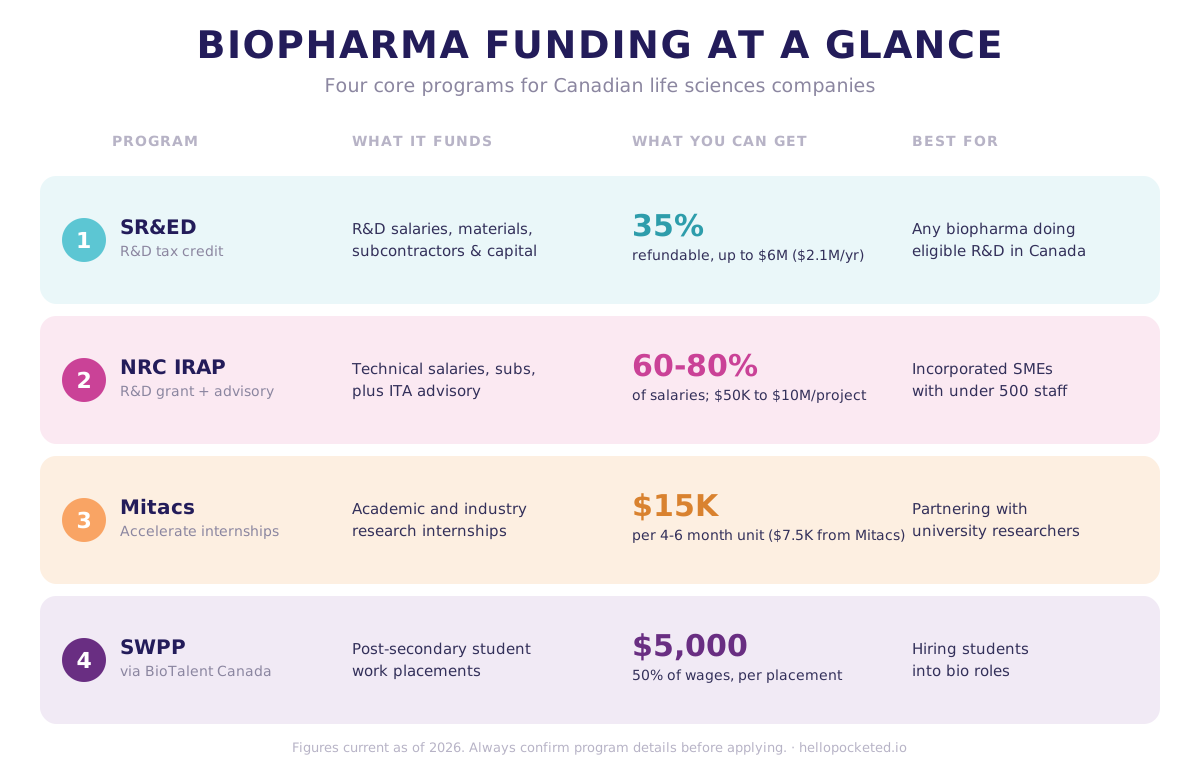
The Four at a Glance
Other Programs Worth Knowing
Beyond the core four, biopharma companies should keep an eye on the Canadian Institutes of Health Research (CIHR) for health-research grants, Genome Canada for genomics-focused projects, and the federal Strategic Innovation Fund for large-scale biomanufacturing and commercialization. These run on their own cycles and criteria, so check current intakes before building them into your plan.
How to Win Biopharma Funding
- Lead with scientific merit and impact. Reviewers fund work that advances human health — make the rationale, the methodology, and the patient outcome unmistakable.
- Stack strategically. Map which program covers which cost (SR&ED for the tax side, IRAP for salaries, Mitacs for research talent, SWPP for students) and stay under the 75% total-assistance cap.
- Mind the sequence. IRAP and Mitacs need approval before you spend; SR&ED is claimed after. Plan your cash flow around both.
- Get help when the dollars are big. For six- and seven-figure R&D claims, expert support typically pays for itself.
Canada wants to fund your science — the hard part is navigating the maze. Pocketed’s intelligent matching platform surfaces every program your biopharma business qualifies for, and our expert grant writers can take the application off your plate.