Say the word “grant” to most business owners and they picture the same thing: a government program with a long form and a longer wait. That picture is not wrong. In Canada, government funding is where most business grant money lives. But it is only half the map.
There is a second, quieter source of grants that sits entirely outside government: foundations, corporations, community funders, and industry groups. The amounts are usually smaller and the programs come and go, but the competition is often lighter and the fit can be remarkably precise. Knowing both worlds, and how they differ, is how you stop leaving money on the table.
Here is how the two compare, with real Canadian examples of each.
Table of Contents

Government grants: where the money is
A government grant comes from exactly where it sounds: a federal, provincial, or municipal government. This is the larger of the two worlds by far, and for most Canadian for-profit businesses it is where the serious money sits.
The anchors are familiar. SR&ED returns up to 35% of eligible R&D as a refundable tax credit, on up to $6 million of spending. NRC IRAP covers a large share of technical salaries for innovative small businesses. The Student Work Placement Program subsidizes student hires at 50% of wages up to $5,000, and Canada Summer Jobs does similar for youth roles. Below the federal level, every province runs its own programs through agencies like Alberta Innovates, Innovate BC, and the Ontario Centre of Innovation. One quick clarification, since it trips people up: those provincial agencies are still government. An arm’s-length Crown agency handing out provincial money is a government grant, not a private one.
What to expect from this world: larger amounts, structured and competitive processes, genuine reporting and compliance obligations, and funding that is usually either non-repayable or delivered through the tax system. It takes more effort, but it is also where the biggest cheques are written.
Non-government grants: the quieter world
A non-government grant comes from a private source. That includes private and family foundations, corporate giving and social-responsibility programs, community foundations, industry associations, and the pitch competitions and accelerator awards that hand out cash prizes.
A clean example is The Awesome Foundation, which gives no-strings micro-grants of $1,000 through local volunteer-run chapters across Canada. It is small, but it is fast, flexible, and refreshingly free of red tape. The line between the two worlds is not always sharp, though. The Canada Media Fund, which finances screen and digital content, is a public-private partnership, government and industry money pooled together, which is a reminder that “private” and “public” sometimes blend.
One honest caveat about this world: a lot of foundation and corporate funding is aimed at nonprofits and community projects rather than for-profit companies. As a business, you most often tap this side through competitions, accelerator awards, industry-association programs, and corporate initiatives, many of which target specific groups like women-led, Indigenous-led, or youth-led ventures. The amounts are typically smaller, and the programs are less permanent. The FedEx Small Business Grant Contest was a fixture for over a decade before it wrapped up in 2024, which is a good illustration of how these come and go.
What to expect here: smaller awards, lighter competition in the right niche, faster and more flexible processes, and funders driven by a mission or set of values rather than an economic-development mandate.
How they actually differ
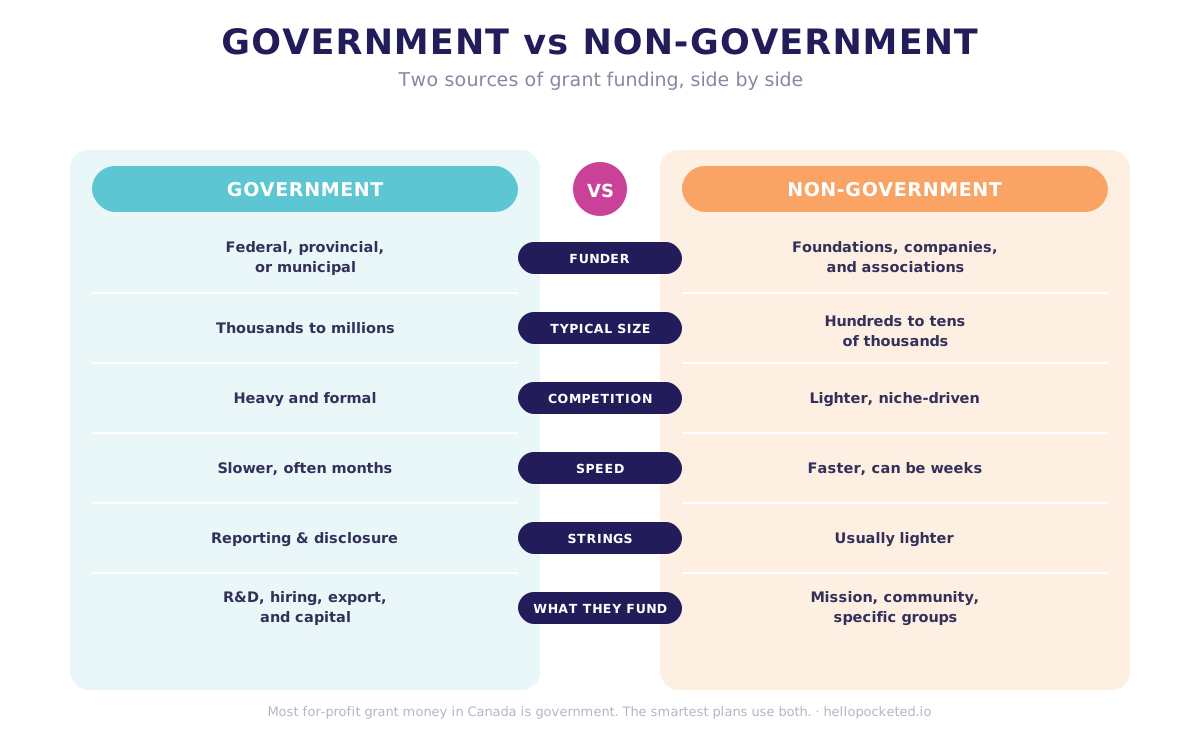
The two worlds behave differently across the dimensions that matter:
The funder is a government body on one side and a foundation, company, or association on the other. Typical size runs large on the government side, from thousands to millions, and smaller on the private side, often a few hundred to tens of thousands. Competition is heavy and formal for government programs and lighter but more idiosyncratic for private ones. Speed and flexibility favour the private side, where a small foundation can decide in weeks, while government timelines stretch into months. Strings are heavier with government money, which carries real reporting and disclosure rules, and lighter with many private grants. And what they fund tends toward R&D, hiring, export, and capital on the government side, versus mission, community, and specific-group priorities on the private side.
Which should you go after?
For most Canadian for-profit businesses, start with government. It is simply where the volume and the largest non-repayable dollars are. SR&ED and IRAP alone can outweigh a stack of private grants, and they are available year after year rather than as one-off contests.
That said, do not ignore the private world, especially if you fit a mission category, want speed, or want to sidestep the crowded federal competitions. A $1,000 micro-grant or a $25,000 pitch-competition prize is real money won with a fraction of the paperwork, and these wins often come with mentorship, visibility, and connections attached. The strongest funding plans pull from both: government for the big structured needs, private for the niche, the fast, and the mission-aligned.
The catch with using both is that they live in completely different places, and the private ones are scattered and easy to miss. That is exactly what Pocketed’s matching platform is built to solve, surfacing government and non-government grants you qualify for in one place. And once you have your shortlist, our guide on how to choose the right grant helps you decide which ones are actually worth your time.