


Top Grants for Canada's Food and Beverage Industry (2026)
Building a food or beverage company in Canada has never been more exciting, or more capital-hungry. Whether you are perfecting a plant-based protein, extending shelf life with a cleaner preservative, or automating a production line, the work eats cash long before it earns it. The encouraging part is that Canada treats food innovation as a strategic priority, and there is real money set aside to help you build.
The hard part is that the funding is spread across a dozen agencies and programs, each with its own rules and timing. So rather than list them all, this guide organizes the best options around what you are actually trying to do: innovate, scale, hire, sell into new markets, and go green. Find your goal, and you will find your funding.
Discover More: For the bigger picture on research funding, start with our Ultimate Guide to Funding Your Innovation Projects.
Table of Contents
What Actually Wins a Food and Beverage Grant
Before the programs, a quick word on what funders actually reward, because the same handful of things decide most outcomes.
Start by aligning tightly with the funder’s mandate. Every program has a focus, whether that is sustainability, plant protein, or processing technology, and the closest-aligned applications win. Read the guidelines and mirror their priorities back to them. From there, make the impact concrete and measurable. Reviewers want to see who benefits and by how much, so quantify the jobs, the emissions saved, or the shelf-life gained rather than speaking in generalities. Back it with a credible, itemized budget that shows exactly how each dollar is spent, because a vague budget sinks strong ideas. Tell the story clearly, in plain language a non-specialist can follow. And once you win, keep the funder updated with progress and results, since a good reporting relationship is often what unlocks the next round of funding.
None of this is glamorous, but it is the difference between a funded application and a near miss.

Goal 1: Innovate Your Product
This is where the richest food and beverage funding lives, and it is the natural starting point for most agri-food tech startups.
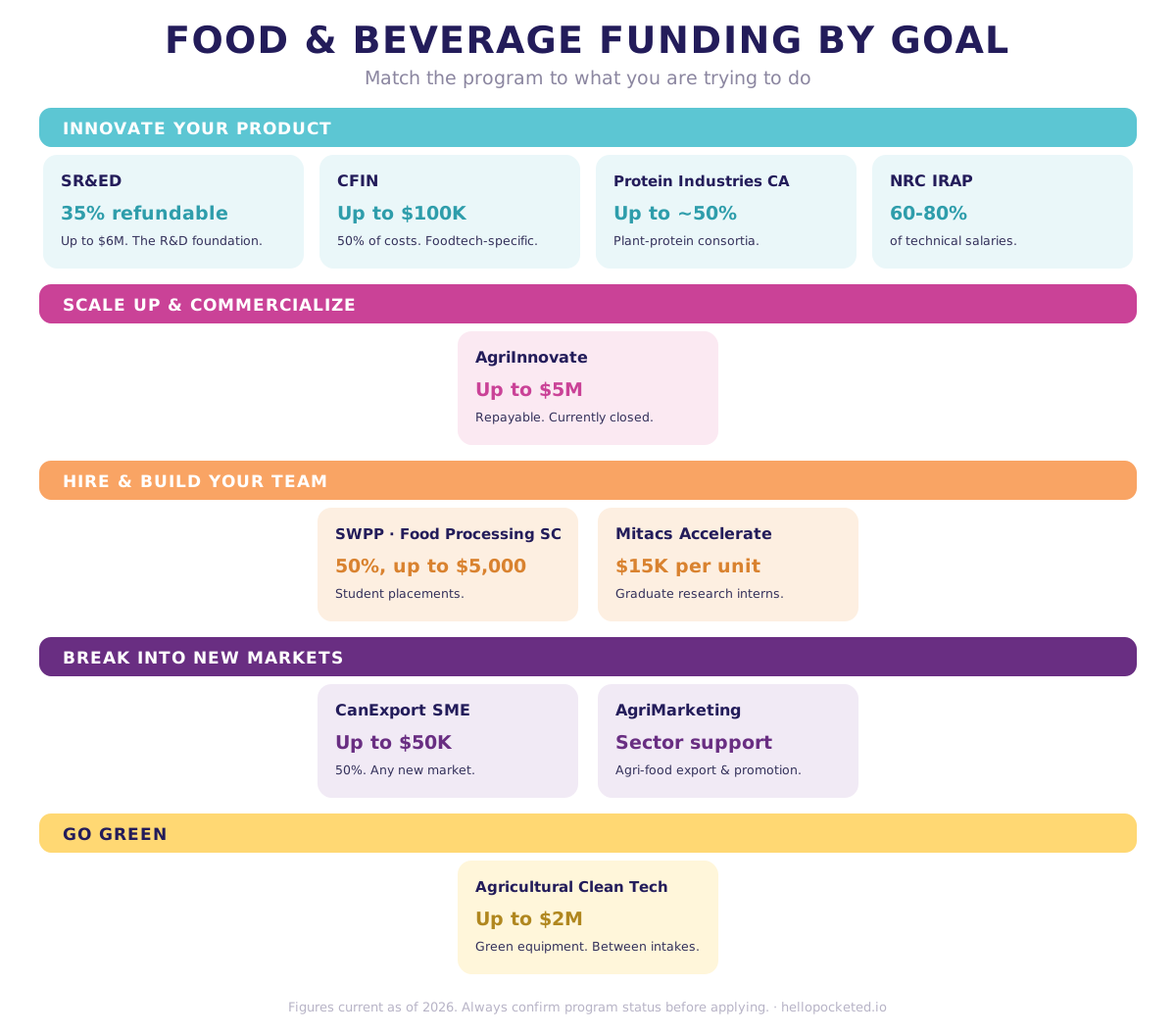
Your foundation is SR&ED. If you are reformulating recipes, extending shelf life, or solving real technical problems in your process, that work likely qualifies as experimental development. As of 2026, Canadian-controlled private corporations can claim a 35% refundable tax credit on up to $6 million of eligible R&D, worth as much as $2.1 million back per year. Almost everything else stacks on top of it.
The program built specifically for your sector is the Canadian Food Innovation Network (CFIN). Membership is free, and its Innovation Booster stream covers up to 50% of project costs to a maximum of around $100,000, while its Innovation Scouting Fund offers up to 60% to $75,000 for a foodtech pilot with an industry partner. Both target small and medium food and beverage companies and fund work at early technology-readiness levels, which makes CFIN a natural fit for a startup proving out a concept. Worth noting: its largest stream, the Food Innovation Challenge, is currently paused, so focus on the two smaller streams for now.
If you are working in plant protein, fermentation, or novel ingredients, Protein Industries Canada is one of the country’s most generous backers. As one of Canada’s Global Innovation Clusters, it co-invests up to roughly half of a collaborative project’s costs, with no fixed ceiling, and it recently received $150 million in new federal funding. The catch is that it funds consortia rather than solo applicants, so you will need at least one partner, but for the right alt-protein or ingredient startup the scale is hard to beat.
Rounding out the innovation toolkit is NRC IRAP, which funds technical salaries for incorporated SMEs with fewer than 500 employees, covering roughly 60% to 80% of those costs and pairing the money with a hands-on advisor.
Doing custom development? Our SR&ED specialists can handle the claim.
Goal 2: Scale Up and Commercialize
Moving from a validated product to commercial volume usually means a bigger facility, new equipment, or a production line, and the marquee program here is AgriInnovate. Run by Agriculture and Agri-Food Canada, it provides repayable contributions of up to $5 million, covering up to 60% of eligible costs for commercializing or adopting innovative agri-food technologies and processes, including the capital costs of building or modernizing a facility. Two things to keep in mind: it is a repayable contribution rather than a grant, so think of it as a subsidized loan, and it is currently closed to new applications. The program runs through 2028, so watch for the next intake to reopen, and line up your business plan in the meantime.
For general scale-up that is less strictly agricultural, Canada’s regional development agencies, such as PrairiesCan, FedDev Ontario, and their counterparts, offer growth financing worth exploring alongside AgriInnovate.
Utilize Pocketed’s platform or hire a grant writer to time these applications well.
Goal 3: Hire and Build Your Team
Talent is expensive, and three programs make it cheaper. The federal Student Work Placement Program subsidizes student placements, and for food and beverage it is delivered by Food Processing Skills Canada, the sector’s workforce body. It covers 50% of a student’s wages up to $5,000 per placement, which is an easy first hire. For research talent, Mitacs Accelerate connects you with graduate students and postdocs at $15,000 per four to six month internship unit, with Mitacs covering half. And if your hiring lines up with summer, Canada Summer Jobs subsidizes youth wages on an annual cycle.
For the full picture, see our Ultimate Guide to Hiring Grants.
Goal 4: Break Into New Markets
Once your product is ready for shelves beyond Canada, two export programs help cover the cost of getting there. CanExport SME reimburses up to $50,000, covering up to half the cost of breaking into a new international market, from trade shows to market research to certifications. Alongside it, the agri-food-specific AgriMarketing program supports market development and promotion for the sector, with an SME stream that can cover a meaningful share of those costs. The two can often be used together to extend your reach.
Goal 5: Go Green
Sustainability is no longer optional in food and beverage, and funders are leaning in. The Agricultural Clean Technology Program supports the adoption of clean technology, covering investments like energy-efficiency upgrades, green processing equipment, and emissions reductions, with project support reaching up to $2 million. It runs in intake windows and is currently between intakes, so check Agriculture and Agri-Food Canada for the next opening and prepare now. Going green also strengthens applications everywhere else, since measurable environmental impact is exactly what most of the programs above want to see.
The Programs at a Glance
How to Put It All Together
The startups that fund themselves best rarely lean on a single program. They layer them. A plant-protein company might run R&D through a Protein Industries Canada consortium, claim SR&ED on its own development costs, bring in a Mitacs intern for a specialized question, and tap CanExport once it is ready to sell abroad, all while staying under the 75% cap on combined government support. The trick is matching each program to the goal in front of you and minding the timing, since programs like IRAP need approval before you spend while SR&ED is claimed after.
That is a lot to track across a dozen agencies, which is where we come in. Pocketed’s intelligent matching platform surfaces every program your food and beverage business qualifies for, and our expert grant writers can take the application off your plate.
Canada wants to fund the future of food. With the right plan, your company can be part of it.